
Going multiplayer mode
The shift most teams haven’t made yet.
AI adoption at work is now a given. But meaningful team-level transformation that truly reinvents how work is done and delivers organisation-level success is far less common.
In this episode of Prompted, we’re seeing no shortage of enthusiasm from leaders at some of the most forward thinking companies in tech, from Google to Anthropic.
I sat down with Sherif Mansour, Head of AI at Atlassian, to unpack why.
Sherif has spent more than 16 years at Atlassian shaping products like Jira and Confluence. He’s lived through the web era, the cloud shift, mobile, and now with AI, he’s in the position of rebuilding the apps he’s worked on for over a decade.
We dug into AI’s shift from single player (prompt > output) to multiplayer mode, where teams are effectively using agents and LLMs together in a shared workflow - and Sherif has a few ideas on what it really takes to do this well.
This conversation was recorded late last year, and in that time the use of agents for knowledge work has gone from future-state to something that’s here, now. The examples from inside Atlassian are a great starting point for anyone looking to get their teams collaborating with agents more, but aren’t sure where to start.
👉 Listen to Episode 14 with Sherif Mansour
Key Ideas — Operationalizing AI
1. The shift most teams haven’t made
Sherif described a progression he sees across companies. Most teams begin by using AI individually (asking questions, drafting emails, experimenting). That can boost productivity, but it rarely changes how the organization runs.
The real shift happens when AI is embedded inside a team workflow.
Not replacing everything, but improving a specific step.
*Examples*: Before a customer meeting, Sherif can generate a briefing that pulls from Slack, proposal history, CSAT data, and internal systems. That’s not just a well-written prompt; it’s AI integrated into a defined process.
Atlassian also uses AI to analyze thousands of customer feedback inputs each week, grouping themes and suggesting next steps. Humans remain in the loop. AI handles aggregation. People handle judgment.
That’s the difference between experimentation and operational change.
2. Fix the workflow, not the use case
Many organizations search for a “killer AI use case.” Sherif sees the teams making progress by taking a simpler path.
They examine what already exists and consider:
Where is there friction?
Where is work repetitive?
Where are decisions delayed?
Instead of inventing something new, they improve an existing process.
It’s less about novelty and more about clarity.
3. As AI increases output, strategy becomes higher leverage
AI allows teams to produce more, faster. More ideas, more prototypes, more feedback cycles. But increased output doesn’t create direction.
As Sherif noted, humans increasingly become the constraint, not because they can’t execute, but because they must decide.
*If strategy isn’t clear, teams simply move faster in the wrong direction.*
In that environment, leadership needs to shift from doing the work to architecting it: setting goals, defining constraints, and maintaining coherence as execution accelerates.
4. Adoption requires psychological safety & synchronised experimentation
Behavior change doesn’t happen through policy. It happens through shared experience.
Sherif shared how Atlassian ran an AI Builder Week, pausing normal work and encouraging teams to experiment together. The goal wasn’t perfection. It was learning.
Psychological safety and synchronised time made experimentation legitimate, not extracurricular. It reduced guilt.
And that’s often what turns curiosity into capability.
A Note on Talent
The next generation of builders will be AI-native. While many are worried about career prospects for junior talent, Sherif actively wants to hire them.
The Prompt Segment
At the start of the episode, Sherif shared a childhood story about collaborative comic drawing, each person adding to the narrative panel by panel.
It’s a fitting metaphor for how he sees AI: not as a replacement for human creativity, but as a collaborator in an evolving story.
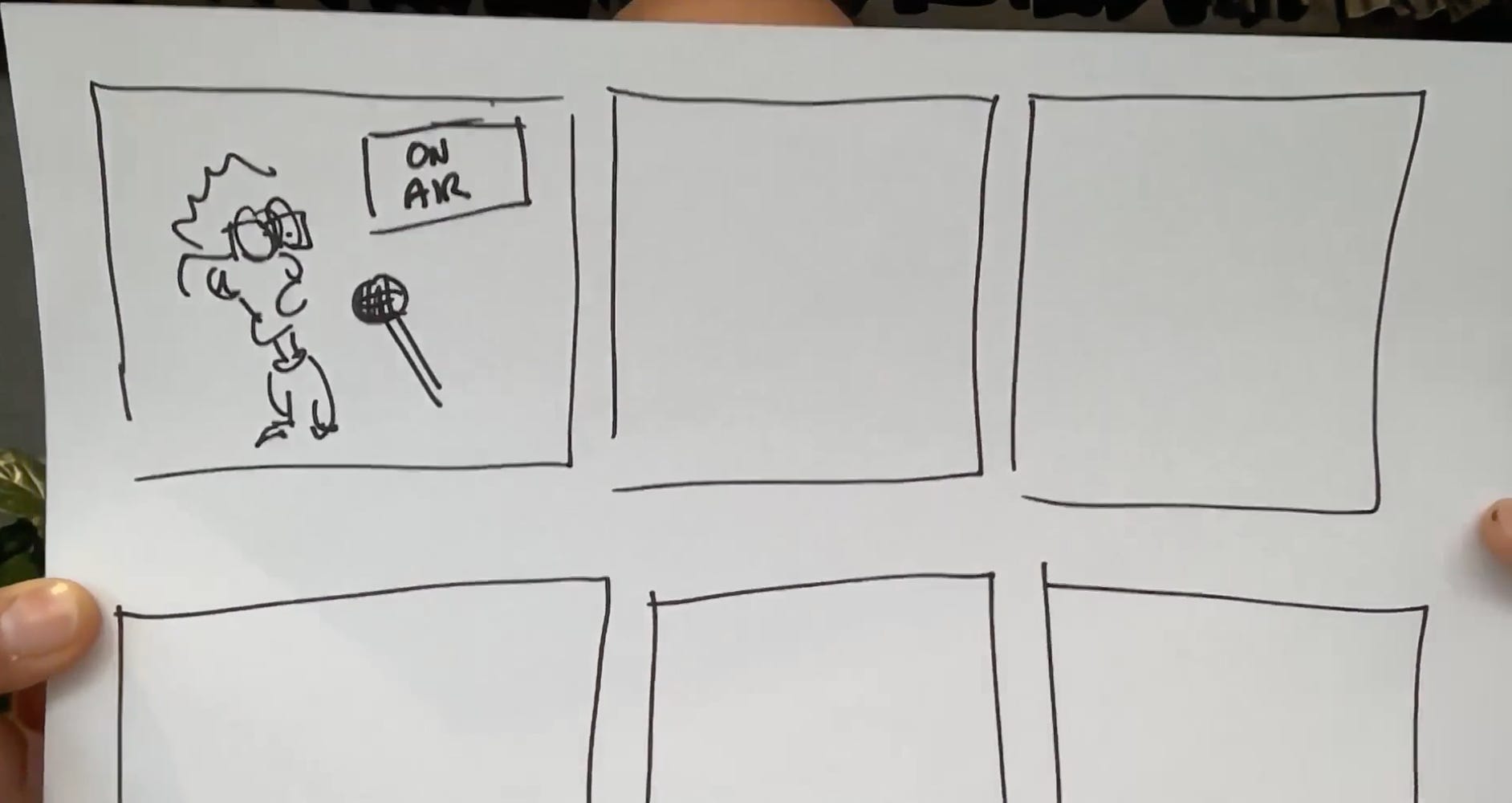
Our Designer-in-Residence, Yvonne You, teamed up with AI to turn Sherif’s sketch into a short visual narrative.
🎨 Tips from Yvonne:
When prompting a video animation with Canva AI, think of it as giving clear, simple instructions so the tool understands exactly what you want.
Start by explaining the goal and where the video will be used. For example: a school project, a birthday invite, a social post, or a product promo.
Describe the movement, not just what appears on screen. Use everyday action words like slide in, fade out, zoom closer, pop up, or move slowly across the screen.
Add a few style and mood words to shape the look, such as minimal, bold, playful, calm, professional, or cinematic.
Be clear about the pace and energy. Should it feel relaxed and smooth, or fast and exciting? If your video has several moments, break it into simple steps or scenes so it flows in the right order.
And if you’re not sure how to describe the style or camera angle, explore the options under the “Style” and “Framing” tabs in Canva AI - Video Clip. They’re a great starting point and can help you build confidence as you refine your prompt.
Thanks for tuning in.
Keep creating,
Cameron
Co-founder & Chief Product Officer, Canva
Interview Excerpts
Cam: Most AI tools feel like they’re in single-player mode. Where does AI need to go to become truly collaborative?
Sherif:
“I have this framework internally around the maturity… You always hear three rough stages of the story. Stage number one is like, I type things into the AI, and I get answers to my questions. Stage number two is the aha moment that, wait. It can help do things for me, generate that media for me, give me a draft idea, help design the website for me. That’s sort of the second stage. The third stage is like when we start to deploy these, I call them virtual teammates, these new teammates with us in team workflows every day. You’re getting an AI agent and you’re deploying it in some sort of business workflow.”
Cam: Your research shows 96% of companies haven’t seen major AI transformation yet. Why is that?
Sherif:
“I think it’s pretty spot on. Companies are taking the first step where they’re saying there is a lot of individual productivity, but it’s quite hard to measure. It’s like fluffy. The ones that are getting the best impact, they’re looking at, what are my teams already doing? They’re coming at the problem from quite a different angle… What’s my business already doing and where can I improve things?”
Cam: You mentioned agents working best inside workflows. Where are you seeing that actually work?
Sherif:
“The companies that are doing amazingly well with AI and they’re deploying agents and AI already have a workflow modeled in their business… at each step of the workflow… they’re looking going, oh, I could add AI here to either reduce time or maybe increase the creativity… And that’s where we’re seeing the most leverage happen.”
Cam: As AI increases output, do humans become the bottleneck?
Sherif:
“You’re spot on. There’s more work to do. AI does an amazing job and helps us prioritize, but what’s then more important is really around directing the ship and the strategy becomes the most important high-leverage exercise. You could be building a lot of stuff, but the boat’s headed in the wrong way. The worst thing we could do is feel like we’re a bottleneck and keep scatter gunning everything without any sense of direction, and then we’ll just be going around in circles.”
Cam: How do you actually make adoption happen inside a company?
Sherif:
“What I’ve seen have the biggest impact, is we ran an AI builders week where we had a thousand people stop what they’re doing. We created some psychological safety. It was, one, everyone sit at a synchronized time. We’re stopping so you don’t feel guilty about taking time. Two, we’re giving people space and we’re giving them space to say that the success of this week is learnings. It’s not an outcome. You’re probably going to get lots of failure. We’re going to celebrate what you learned. People want to rethink how they could do their job better. They just haven’t had the space. And as leaders, our job is to work out which constraints we want to relax, and be okay with that to encourage that behavior and reward learnings. At the end of the week, we’d celebrate the biggest fail as a joke, but also as a celebration of the most ambitious project that didn’t work.”