


I recorded this episode with Rong Yan, CTO of HeyGen, just after our AI Vision event in New York.
What struck me most wasn’t just the technology he’s building around AI-generated avatars and video. It was his perspective on what actually matters now that these tools exist.
Because if anyone can generate content, code, or even a human presence on screen… what differentiates people?
Rong’s answer is simple, but not easy: it’s no longer about what you know. It’s about how quickly you can learn, adapt, and apply.
That shift has pretty deep implications—for how we build teams, how we communicate, and how we show up in a world where AI can increasingly act on our behalf.
👉 Listen to Episode 12 with Rong Yan
Key Ideas — Learning Velocity, AI Companions, and Communication
1. The end of knowledge as a moat
One of the most direct things Rong said stayed with me: “I don’t believe in accumulations… A 10x person is not winning by accumulating knowledge… [they’re] the one that can learn the quickest, that can adapt the quickest, and they can leverage the tools they have at hand to make themselves better.”
For most of our careers, expertise has been built on accumulation. Years of experience, deep domain knowledge, hard-earned intuition. But in a world where tools can generate, translate, and reason alongside you, that advantage compresses quickly. What doesn’t compress is your ability to keep updating yourself.
Rong’s framing is that velocity has become the new moat. Not just learning fast once—but continuously letting go of what you knew and rebuilding on top of what’s changed.
2. AI isn’t replacing people—it’s pairing with them
There’s a lot of conversation about automation replacing human work. That’s not how Rong thinks about it.
At HeyGen, they’re exploring the idea of every employee having an AI “companion”—something that sits alongside you, learns from your work, and helps you execute.
“We always believe AI is not a replacement for humans. It’s a tool… if you use it well, you can actually improve the quality of the humans.”
What I like about this framing is that it keeps the human in the loop, but expands what they’re capable of. Not less work. Different work. Less repetition. More direction. And importantly, more leverage.
3. Communication is shifting from text to video
One of the clearest use cases Rong shared was internal communication. Instead of sending a roadmap as a spreadsheet, he generates a short video—his avatar explaining it, with visuals layered in. It takes minutes.
“I just changed it to a two minute video… my avatar speaking for the roadmap… it takes me about five minutes to generate the video.”
The interesting part isn’t the tool itself. It’s the shift in medium. Most work today is still text-based. Docs, slides, emails. But if video becomes just as easy to produce, that changes how ideas are shared and consumed inside companies.
More context. More clarity. Less friction to engage.
4. Trust becomes the real constraint
As AI-generated video gets more realistic, the technical challenge becomes less about quality—and more about trust. Rong has a simple test for whether something should be AI-generated:
“If you openly, explicitly tell them this is an AI generated video, and they don’t feel offended… pass the test.”
That’s a useful heuristic. It suggests that transparency isn’t a limitation—it’s a design principle. And that not every use case benefits equally from AI. In some cases (like influencer content), authenticity still depends on a real human presence. In others (like knowledge sharing), value matters more than origin.
5. More content isn’t the problem—better content is
There’s a common concern that AI will flood the world with content. Rong sees the opposite problem.
“It’s not about the volume of the contents… we don’t have good content… the producing cycle of traditional videos is so long… months is too long.”
If creation becomes faster, the bottleneck shifts. Not distribution. Not production. Taste. Judgment.
What’s actually worth making—and worth watching.
6. Ride the wave, don’t resist it
One of the underlying themes in this conversation is how quickly norms shift—and how little control we have over that. Rong draws a parallel to previous platform shifts, where initial resistance eventually gives way to adoption.
“When a paradigm is shifting… the only way you can deal with it is to accept it and make the best use out of it… you just need to know how to ride a wave instead of blocking the wave.”
This feels particularly relevant right now. There’s a natural instinct to question, slow down, or even reject these changes—especially when they affect how we work or how we communicate. But the people who seem to benefit most aren’t the ones debating whether the shift should happen.
They’re the ones learning how to operate inside it early.
That doesn’t mean blind adoption. It means active participation. Understanding where the technology creates leverage, where it introduces risk, and how to shape it through how you use it.
Because whether we like it or not, this wave is already here.
The Prompt Segment
Rong’s story starts with a moment that feels familiar to a lot of builders.
At nine years old, his dad brought home their first computer. It wasn’t common at the time—he estimates maybe 1% of families had one.
That moment sparked everything.
He started coding, hacked together his first game in BASIC, and stayed up until 2am building it.
A small moment. A long trajectory.
Rong’s sketch:
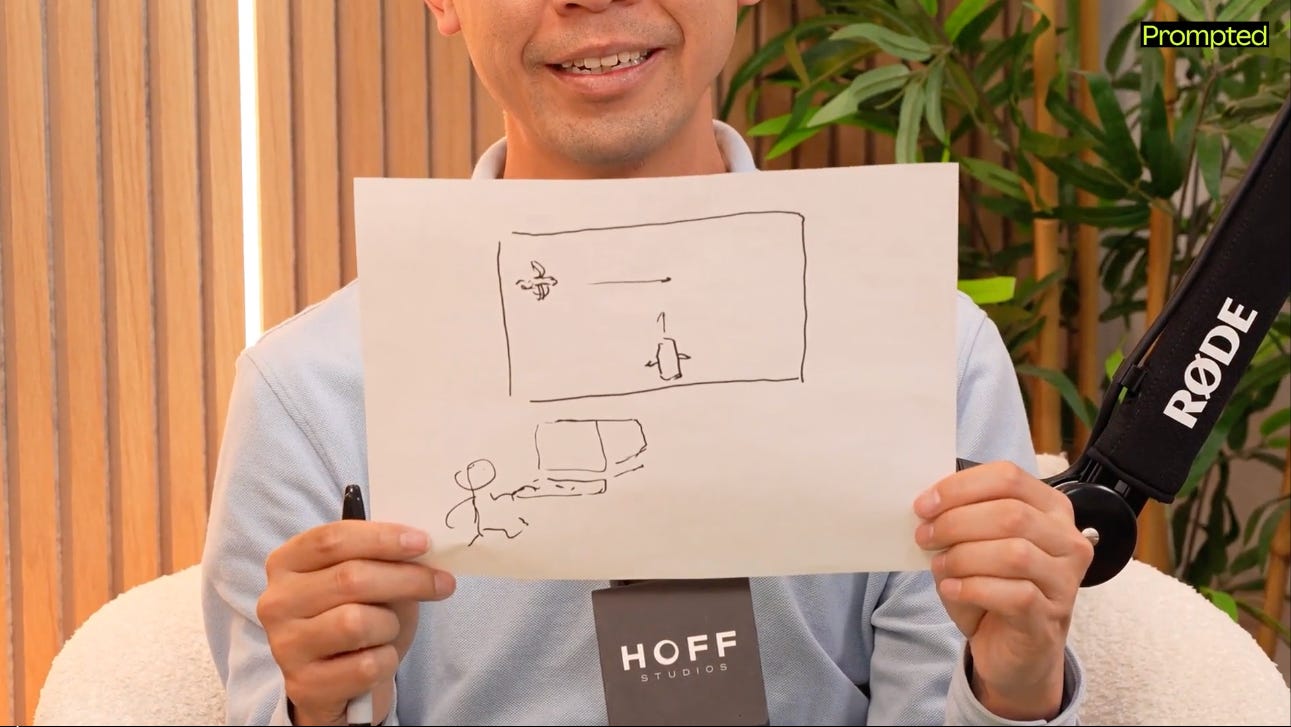
Frasat Farooq, Designer-in-Residence, teamed up with AI to turn Rong’s sketch into an interactive storytelling experience.
Tips from Frasat:
1. AI is an enhancer, not a mind-reader
Come in with a thorough idea. The more detail and direction you give, the better the output. Always ask the chat model (Grok, ChatGPT, etc.) clarifying questions, it forces both of you to get on the same page.
2. Iteration is everything
Whether it’s lyrics, prompts for images, or music: generate → refine → generate again. Don’t settle on the first result.
3. You are the studio
Every AI tool is just one crew member (Grok for ideas & lyrics, Suno for music, Leonardo for imagery or video, ElevenLabs for voice, Canva for final assembly). The more familiar you are with the tools, the closer you get to 100% of your vision.
4. Reference images are magic
Using Rong’s original drawing as a reference let me put that exact game on the TV screen in front of his younger self, that level of consistency and storytelling is hard to get without strong references.
Thanks for tuning in.
Keep creating,
Cameron
Co-founder & Chief Product Officer, Canva
Interview Excerpts
Cam: How do you think about what differentiates people in an AI world where tools can do so much?
Rong: “I don’t believe in accumulations… A 10x person is not winning by accumulating knowledge… [they’re] the one that can learn the quickest, that can adapt the quickest, and they can leverage the tools they have at hand to make themselves better.”
Cam: Do people still need years of experience to build meaningful things?
Rong: “I feel like almost my knowledge accumulating over the last 20 years are all gone… the important thing is to really embrace the fact that velocity is really fast right now… you just cannot stop.”
Cam: There’s a lot of fear around AI replacing people. What are you actually seeing?
Rong: “We always believe AI is not a replacement for humans. It’s a tool… if you use it well, you can actually improve the quality of the humans.”
Cam: What does this shift look like inside a company day to day?
Rong: “I just changed it to a two minute video… my avatar speaking for the roadmap… it takes me about five minutes to generate the video.”
Cam: How should we think about trust in a world of AI-generated content?
Rong: “If you openly, explicitly tell them this is a AI generated video, and they don’t feel offended… pass the test.”
Cam: Are we heading toward a world of too much content?
Rong: “It’s not about the volume of the contents… it’s about the volume of good contents… we don’t have good content… the producing cycle of traditional videos is so long.”